



RELATED POSTS
Other posts you may be interested in
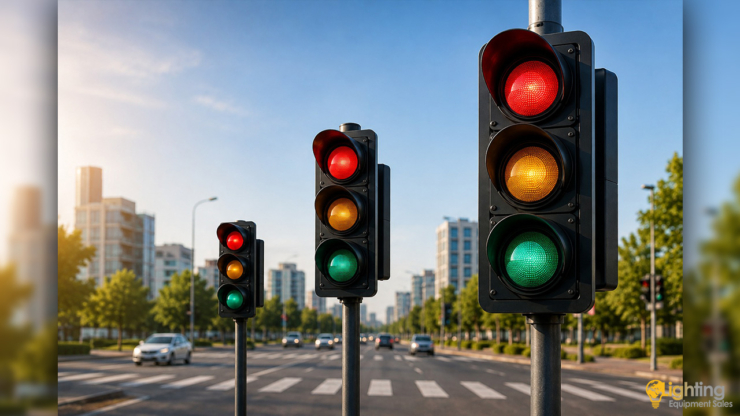
Most people probably do not pay much attention to the size of traffic lights. We see them every day, wait for the green light, and continue driving.
But once you start noticing them, you may realize that not all traffic lights are the same size. Some look quite small, while others are much larger and easier to see from a distance.
This is not just a design choice. The size of a traffic signal is usually selected according to where it will be used and how far away drivers need to see it.
Traffic signal lenses are generally produced in three main sizes:
These measurements refer to the diameter of the signal lens.Each size is suitable for a different type of road or application.
100 mm traffic lights are the smallest option.
They are not usually used at large public intersections because they may be difficult to see from a long distance. Instead, they are more suitable for places where vehicles move slowly and drivers are already close to the signal.
For example, they can be used in parking areas, factories, private roads, toll systems, bicycle routes or indoor traffic applications.
In these locations, a larger signal may not be necessary.
The 200 mm size is probably the one most people see in cities.
It is large enough to be clearly visible in normal urban traffic, but it is also compact enough to be used at standard intersections without requiring a very large signal body.
This makes it a practical choice for residential roads, city centers, pedestrian crossings and normal-speed urban streets.
For many projects, 200 mm traffic lights provide a good balance between visibility, cost and installation requirements.
300 mm traffic lights are generally used when visibility is especially important.
On wide roads, high-speed routes or large intersections, drivers may need to see the signal from much farther away. A larger signal makes the light easier to notice and gives the driver more time to react.
These signals are often used on main roads, multi-lane intersections and locations where the viewing distance is longer than usual.
They can also be useful in areas with strong sunlight, fog, rain or other conditions that may reduce visibility.
Not always. A larger signal may be easier to see, but that does not mean every intersection needs a 300 mm traffic light.
Using an oversized signal in a small parking area or on a low-speed road may increase the cost without adding much benefit.
The correct size depends on several things, such as road speed, number of lanes, viewing distance, intersection design and local standards.
In traffic signal projects, the aim is not to use the biggest product. The aim is to use the right product for the location.
Modern traffic lights usually use LED modules, which provide better brightness and lower energy consumption compared to older lamp-based systems.
However, even with LED technology, size still matters.
A bright 200 mm signal may work very well in normal city traffic, but a 300 mm signal will still be easier to recognize from a longer distance because the illuminated area is larger.
So, brightness and signal size work together.
Traffic lights need to be noticed quickly and understood without confusion.
If a signal is too small for the road, drivers may see it too late. If it is unnecessarily large, the project may become more expensive than required.
Choosing the correct size helps improve visibility, road safety and the overall efficiency of the traffic signal system.
Traffic light size may seem like a small detail, but it has an important purpose.
A 100 mm signal may be perfect for a parking facility, while a 300 mm signal may be necessary on a wide, high-speed road. The correct choice depends entirely on the conditions of the project.
So, the next time you stop at a traffic light, take a quick look at its size. There is probably a practical reason why that particular signal was chosen.



COMMENTS
MAKE A COMMENT